AI Server Liquid Cooling: Cold Plates, Manifolds, and FSW
Demand for AI computing is growing rapidly, and cooling pressure on data centers is rising with it. Traditional air cooling is increasingly unable to balance performance, energy consumption, and space layout when dealing with high-power GPUs, AI servers, and high-density racks. As a result, data center liquid cooling systems, AI server liquid cooling, cold plates, and manifolds have become key items that supply chains have been actively building up in recent years.
For system makers, thermal module makers, and data center equipment suppliers, liquid cooling is not only a thermal design issue. It also involves metal part machining, sealing, flow channel control, joining and welding, and mass-production stability. This is exactly where a precision metal machining plant can add value.
Why Do AI Servers Need Liquid Cooling?
AI servers are equipped with high-power chips and GPUs that generate a large amount of heat during operation. As the power density of a single rack increases, traditional air cooling systems need greater airflow and more energy, and their efficiency gradually becomes limited. Liquid cooling uses coolant to carry heat away directly from near the heat source, lowering thermal resistance and improving cooling efficiency. It also helps data centers reduce overall energy consumption.
This is why more and more data centers are adopting chip-level liquid cooling, cold plate liquid cooling, and rack-level liquid cooling architectures. For enterprise buyers, whether they can find a stable metal part machining supplier directly affects the development schedule and mass-production quality of a liquid cooling system.
Cold Plate: The Core Component of a Liquid Cooling System
The cold plate is one of the most critical metal parts in AI server liquid cooling. It is usually mounted on top of a CPU, GPU, or other high-power chip, and uses internal flow channels to let the coolant carry heat away.
Key points in manufacturing a cold plate include:
- Flow channel dimensions and consistency
- Flatness of the contact surface
- Control of internal burrs
- Machining accuracy of sealing grooves
- Selection of thermally conductive materials
- Airtightness and pressure resistance after joining
If a cold plate is not machined accurately enough, it may cause poor contact, increased thermal resistance, uneven flow, or leakage risks. In high-power cooling applications in particular, a cold plate must not only be makeable, but also be stably mass-produced and meet the requirements of subsequent assembly and testing.
Manifold: Affecting Flow Distribution and System Stability
Besides the cold plate, the manifold is also an important component in a liquid cooling system. It distributes coolant to different cold plates or modules and then returns the liquid to the circulation system. If the internal flow channel design or machining accuracy of a manifold is unstable, flow may become uneven across nodes, which in turn affects overall cooling efficiency.
Common manufacturing challenges for manifolds include multi-hole machining, thread accuracy, sealing surface control, internal channel cleanliness, and assembly consistency. For data center liquid cooling systems, such parts are not merely piping connectors; they are an important foundation for keeping the system running stably.
The Value of Friction Stir Welding (FSW) in Liquid Cooling Parts
In the manufacture of aluminum alloy liquid cooling plates and some thermal modules, friction stir welding is a process worth attention. Compared with conventional fusion welding, friction stir welding is a solid-state joining process that reduces thermal distortion and lowers the risk of porosity and cracks, making it suitable for aluminum alloy cold plates, channel cover plates, and cooling parts with high sealing requirements.
For AI server liquid cooling, the advantage of friction stir welding is that it balances joint strength with airtight stability, helping improve the reliability of cold plates and liquid cooling modules. If a metal machining plant has both CNC machining and friction stir welding capabilities, it can help customers integrate flow channel machining, cover plate joining, flatness finishing, and inspection, reducing the risks caused by hand-offs between multiple suppliers.
EV and AI Cooling Processes Have Much in Common
It is worth noting that electric vehicle (EV) cooling and AI server liquid cooling share many process similarities. Both must deal with high-power heat dissipation, aluminum alloy cold plates, flow channel design, airtightness testing, pressure testing, and long-term reliability requirements.
EV battery cooling plates, motor controller heat sinks, and AI server cold plates all require stable aluminum alloy precision machining capability. The application environments differ, but the core process logic is similar: precise machining, stable joining, strict leak prevention, and traceable quality management.
Therefore, a metal machining plant with experience manufacturing EV liquid cooling parts is usually better placed to understand the manufacturing risks and mass-production requirements of high-power cooling parts when entering the AI server liquid cooling supply chain.
Choosing a Liquid Cooling Parts Machining Plant: Don't Look at Unit Price Alone
For system makers and thermal module makers, once a liquid cooling part develops a leak, abnormal flow, or insufficient contact surface accuracy, the impact goes beyond a single part to the reliability of the entire server and data center equipment. Therefore, when selecting a supplier, you should focus on evaluating:
- Whether it has CNC precision machining capability
- Whether it is familiar with machining aluminum alloy cold plates and liquid cooling modules
- Whether it can provide FSW friction stir welding
- Whether it has airtightness, pressure resistance, and dimensional inspection procedures
- Whether it can support sampling, trial production, and mass production
- Whether it has quality management experience in automotive or other high-specification industries
Tung Shuhn Precision Industrial has long focused on manufacturing precision metal parts, offering CNC machining, FSW, forging, and casting services, with applications covering electric vehicles, liquid cooling, industrial, and special applications. As demand for AI server liquid cooling grows, Tung Shuhn can help customers evaluate the machining and mass-production feasibility of cold plates, manifolds, aluminum alloy cold plates, and related cooling parts.
If you are looking for a Taiwan liquid cooling parts machining plant, an AI server cold plate manufacturer, a manifold CNC machining supplier, or a partner with friction stir welding capability for cold plate joining, please provide drawings and operating conditions. Tung Shuhn Precision can help you build a stable and reliable liquid cooling supply chain from sampling to mass production.
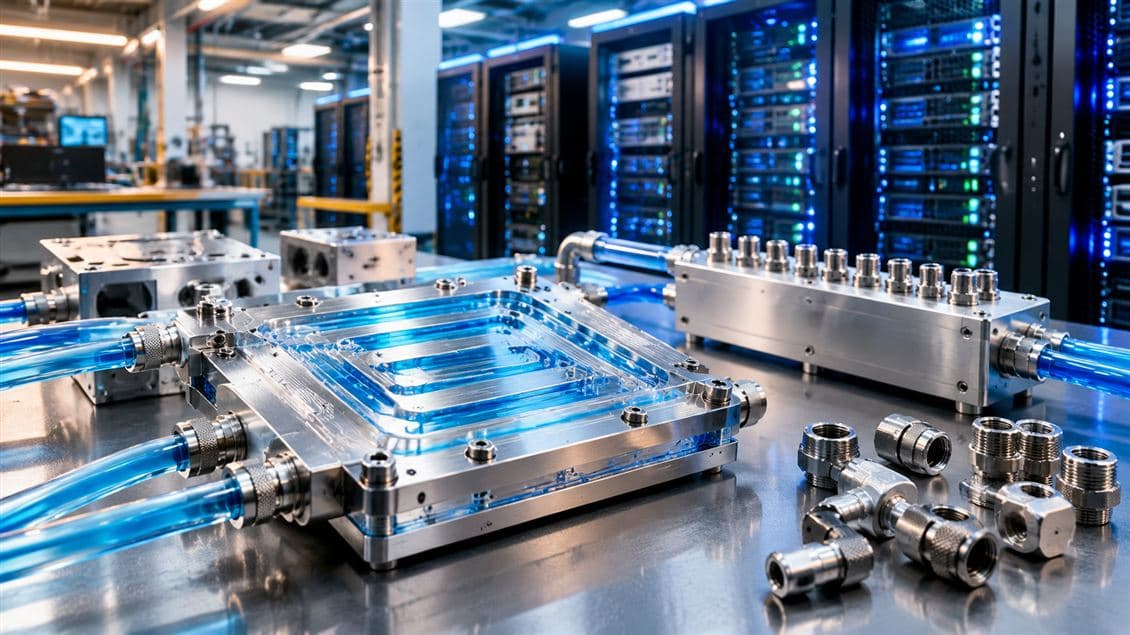
(Image generated by AI)